Tuesday, April 5, 2011

Is Printing the Congressional Record Wasteful?

On a relatively recent visit to the Government Printing Office, I was surprised to learn that despite the great work former Public Printers Bruce James and Bob Tapella have done with FDSys (the system that makes electronic versions of government documents such as the Congressional Record and Federal Register available to the government and the public), the GPO was still printing the Congressional Record–about 1,500 copies DAILY every day Congress is in session, I was told. (And the Federal Register, by the way.) I questioned why that would be, since the information is available online before it is available in printed form. Each issue can be hundreds of pages, depending on what went on in Congress that day. I wondered what happens to all that paper. Where is it stored? Does anyone ever look at it? Why is it even still being printed in those volumes? According to my tour guide, people still wanted the paper. And according to the release cited below, that number is actually 4,551 copies! (I thought 1,500 was low if it was going to everyone, multiple copies to each Congress person’s office, etc.).

Today, Senators Tom Coburn, M.D. (R-OK) and Herb Kohl (D-WI) introduced the Congressional Record Printing Savings Act of 2011, a bill they say would save taxpayers up to $8 million by requiring the Government Printing Office to limit excessive printing of the Congressional Record. According to the release, “The GPO annually spends over $8 million to print hard copies of the Congressional Record that are rarely used since these documents have been digitally available since 1994. Approximately 4,551 copies of the Congressional Record are printed daily [on offset web presses] at the cost of roughly $240 per original page. The Congressional Record Printing Savings Act would require that the distribution of the printed edition is limited to archival purposes and those copies explicitly requested by the Vice President or Members of Congress.”

With digital presses and a DI press in the production mix, paper copies could certainly be produced on demand for archiving purposes or when needed. It is easier to search the electronic copy for the specific nugget someone might want to reference. I can’t imagine anyone curling up with a copy and reading it cover to cover, on a daily basis!

In general, I would support this type of approach, but it needs to be accompanied by a firm commitment to maintain and grow FDSys. My sources tell me that all funding for maintaining/expanding FDSys have been cut. Since Public Printer Bill Boarman (still not officially confirmed despite a recess appointment) refuses to speak to me — and anyone else in the press if my sources are correct — I can’t validate this. However, it would seem that the Senators who put forth this bill should attach a requirement that FDSys continue to be funded at a level that is reasonable to ensure continued access to these valuable documents in perpetuity, according to the mission of the GPO, and to continue to grow the volume of content available on the system as well as continuing to improve accessibility to said information.

Just my two cents worth. More than happy to present Mr. Boarman’s perspective if he would give me 30 minutes of his time for an interview!

Source http://printceo.com/2011/03/is-printing-the-congressional-record-wasteful/

Wednesday, March 23, 2011

76 FR 14777 - US Government Printing Office - FDsys - More Information

76 FR 14777 - Supplemental Standards of Ethical Conduct for Employees of the Federal Labor Relations Authority


Download Files

Metadata

SuDoc Class Number - AE 2.7: GS 4.107: AE 2.106:
Summary - The Federal Labor Relations Authority (FLRA), with the concurrence of the Office of Government Ethics (OGE), is adopting as final, without change, the interim FLRA rule that supplements the executive-branch-wide Standards of Ethical Conduct (Standards) issued by OGE and, with certain exceptions, requires FLRA employees to obtain approval before engaging in outside employment.

Tuesday, March 8, 2011

FDsys Helps GPO Provide Access to Federal Digital Publications

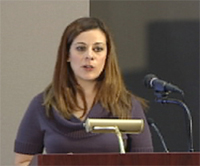
"It’s like an all-you-can eat buffet, but all the options are healthy for you," said Kate Zwaard, the Government Printing Office’s Lead Program Planner for Digital Preservation, in a visit to the Library of Congress on November 16, 2010.

Kate Zwaard

Zwaard was talking about the GPO Federal Digital System , a suite of tools and services that helps the agency preserve and provide long-term access to the digital publications of the Federal government.

A webcast of the event is now available.

"FDsys is a preservation repository in the traditional sense, in that it conforms to the Open Archival Information System reference model (PDF)," Zwaard said, "but it’s also a content management system and an advanced search engine." And while the FDsys is a modern software environment, the roots of the issues it was designed to solve go back to the early days of GPO.

The FDLP worked remarkably well for print publications for over a century, but as agencies opted to host more and more publications on their websites instead of printing them, it became more difficult for users to find what they were looking for. Instead of going to a library or a catalog and looking for an item, you had to know what organization (or sub-organization) was responsible for producing the documents and where they were posted on the web.

More importantly, no federal government entity looked after preservation of the content for public access. Material could be put on a webpage and taken down the next day, or accidentally corrupted, or rendered unusable by obsolescence of technology.

Kate Zwaard

Zwaard described the decisions made by the Public Printer of the United States in 2004 to outline a strategic vision to turn what some called "disruptive technologies" into opportunities. GPO had been publishing content to the web for public access through its website GPO Access since 1993, but the Public Printer’s report lead to the development of the more comprehensive FDsys.

"What sets FDsys apart from most preservation repositories is that it is both a content repository and a system that serves as the electronic backbone of the agency," Zwaard noted. "We’ve built a repository that is designed to maintain the usability of our assets free from dependence on specific hardware and software. But a big part of the system is about providing an organization for content and a workflow to help move publications through the agency for cataloging, proofing, print and possible reuse."

Zwaard went on to describe the technological features of FDsys, including the structure of content packages, the content lifecycle and the GPO approach to content integrity and authenticity.

"We have lots of specialized experience in helping people find the government information they are looking for," she concluded, "and our experts thought carefully about the ways users might navigate to what they want and the kinds of metadata we need to collect to support that. In addition, GPO is preparing for a Trustworthy Repositories Audit and Certification audit . I believe we will be the first Federal agency to be audited for TRAC compliance, and we are excited to have someone take a look at our work and suggest places for improvement."

Source http://www.digitalpreservation.gov/news/2011/20110301_news_zwaard_briefing.html

Industry Day Registration Closed

Registration for the October 6, 2005 GPO FDsys Industry Day is now closed. The meeting will be held at GPO's main facility, 732 North Capitol Street NW, Washington, DC (USA). A more detailed agenda is now available. We will be sending confirmation emails to all registered attendees by 4:00 PM on 9/30/05. In addition, an email will be sent that includes directions to GPO and additional information. Thank you for your interest in FDsys. For additional information, please contact the Office of Innovation and New Technology at int@gpo.gov.

Tuesday, February 22, 2011

Final Library Survey Results

The final results of the Depository Library survey have been posted to the FDsys Web site here. In addition to the results, GPO has identified the following next steps:
  1. Definitions and clarifications of terms used in the survey that respondents indicated were confusing will be posted by October 21, 2005 to the Library Survey Results page on the FDsys Web site.
  2. The survey results indicated areas of interest most important to the library community. Additional interaction with GPO’s library partners is required to validate these findings. GPO will use library focus groups and other means including face-to-face meetings, conference calls, and web conferencing to obtain this input. This initiative will begin in late October 2005.
  3. Feedback from library partners is highly encouraged. All appropriate questions and comments submitted to the FDsys blog (http://fdsys.blogspot.com/) or the Office of Innovation and New Technology’s e-mail address (int@gpo.gov) will be promptly answered. INT will also make questions and answers to frequently asked questions available on the FDsys blog.

Tuesday, February 15, 2011

Clarification of Library Survey Terms

Listed below are definitions for terms used in the FDsys Library survey that some respondents indicated needed additional clarification. Questions regarding this information should be submitted to the Office of Innovation and New Technology at int@gpo.gov.

Push: Intentionally and specifically serving out information to a target recipient(s).
Content is automatically sent (“pushed”) from GPO to a list of interested users. This is analogous to shipping a box of depository documents, only with electronic content instead of tangible copy.

Pull: Downloading content on an as-needed basis.
Content is made available for users to select and retrieve (“pull”) to local servers or computers. For example, currently users may be said to pull documents from GPO Access.

Migration: Preservation of digital content, where the underlying information is retained but older formats and internal structures are replaced by newer.
Migration involves transforming files to ensure that they can be accessed using current hardware and software. The content is retained, but the file format changes as technology changes.
Example: a Microsoft Word 97 file is migrated to a Microsoft Word 2000 file.

Emulation: The imitation of one computing system by another system through the use of software and hardware that allow the latter to run programs written for the former.
Emulation involves re-creating an obsolete operating system or piece of software on an up to date operating system or piece of software. This allows the digital objects associated with the obsolete system to be accessed without changing the file format.
Example: Microsoft Word 97 is emulated on a current system so that files saved in Microsoft Word 97 format can be accessed.

Tuesday, February 8, 2011

Digital Content System Update

The presentation given by Mike Wash at the Fall Depository Library Conference in Washington, DC is available at the Web site here.